Building an MSP that Lasts: Lessons in Simplicity and Legacy
One of the biggest traps we see for MSP owners is getting so caught in the noise of the week that they stop building a business that can actually scale, adapt, and endure. After 30 years in Australian MSPs, Nick and I know that operational maturity does not come from adding more tools, more meetings, or more complexity. It comes from clarity, discipline, and leadership. That is exactly why this episode of MSP Mastery: Ctrl Alt Deliver matters. As we reflected on recent conversations with Brian Dosal, James Vickery, Greg Sharp, and Dean Calvert, what stood out was not just their individual stories. It was how closely their experiences lined up with patterns we have seen again and again across growing MSPs. Each of them has built, run, and evolved an MSP. Each has moved into a different phase of business. And each reinforces a lesson Nick and I have been teaching for years. The lesson is simple. If you want an MSP that is profitable, resilient, and attractive to clients and staff, you have to build it in a way that can operate beyond the founder, beyond the current quarter, and beyond the crisis of the day.
MSP Mastery
5/7/20266 min read
What this episode reveals about building an MSP that lasts
One of the biggest traps we see for MSP owners is getting so caught in the noise of the week that they stop building a business that can actually scale, adapt, and endure. After 30 years in Australian MSPs, Nick and I know that operational maturity does not come from adding more tools, more meetings, or more complexity. It comes from clarity, discipline, and leadership.
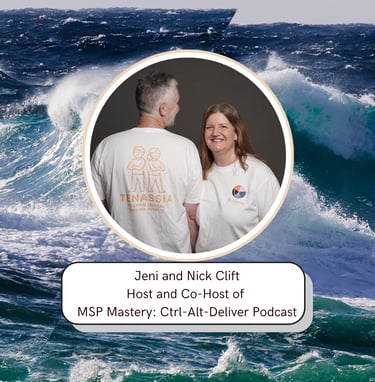
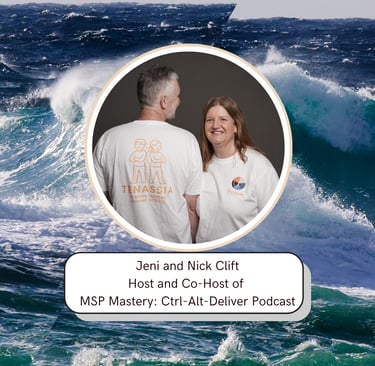
That is exactly why this episode of MSP Mastery: Ctrl Alt Deliver matters. As we reflected on recent conversations with Brian Dosal, James Vickery, Greg Sharp, and Dean Calvert, what stood out was not just their individual stories. It was how closely their experiences lined up with patterns we have seen again and again across growing MSPs. Each of them has built, run, and evolved an MSP. Each has moved into a different phase of business. And each reinforces a lesson Nick and I have been teaching for years.
The lesson is simple. If you want an MSP that is profitable, resilient, and attractive to clients and staff, you have to build it in a way that can operate beyond the founder, beyond the current quarter, and beyond the crisis of the day.
Growth changes the business whether you are ready or not
Founder led energy will only take you so far
One truth that many MSP owners resist is that the business changes shape as it grows. What works when you have a tight team and direct client contact does not work the same way once the business reaches a larger scale. There is nothing wrong with either stage, but they are not the same business.
Nick and I have lived this ourselves. The shift from a smaller owner led MSP to a more structured organisation is not just about more staff. It is about a different operating model. You can no longer rely on intuition, personal oversight, or being involved in every decision. If you try, you become the bottleneck.
Brian Dosal’s story reinforces this beautifully. He spoke about the difference between startup energy and larger corporate structure, and why some founders are energised by the early agile phase but lose interest once the business becomes more layered. That is not failure. It is self awareness. The important thing for MSP owners is to recognise which stage suits them and then build accordingly.
If you want to keep growing, you need leadership structure, clear decision making, and roles that do not depend on one person being everywhere at once. That is where many MSPs stall. They are still being run like a 10 person business long after they have outgrown that model.
Simplicity is a competitive advantage
Most MSPs do not need more data
Another recurring theme in this episode was simplicity. This is one of the most under valued disciplines in service delivery. MSPs are surrounded by platforms, dashboards, automations, and reporting options. It is incredibly easy to confuse more information with better management.
In reality, too much data often hides the real problem. We have seen MSPs generate pages of reports that nobody reads, track metrics that do not influence behaviour, and celebrate numbers that mean very little to the client experience.
Brian’s comments on keeping reporting simple are a strong reminder of what matters. Humans need to be able to read it, interpret it, and act on it. Nick made a point that we strongly agree with. In most cases, you only need a few core indicators to know whether service delivery is healthy. Forgotten tickets, time to resolve, and meaningful service trends tell you far more than vanity measures ever will.
This is especially relevant when MSPs become obsessed with first response metrics that are really just automated acknowledgements. Clients do not feel looked after because they received a system generated email. They feel looked after when the issue is understood, owned, and resolved.
The same principle applies internally. Strategic meetings should stay strategic. Operational meetings should stay operational. When you mix the two, the urgent always wins and the important gets pushed aside. That is why clear meeting rhythms and simple scorecards matter so much. Simplicity is not basic. It is disciplined.
Culture shows up most clearly under pressure
People watch what leaders do, not what leaders say
If you want to understand the real culture of an MSP, do not look at the values written on the wall. Look at what happens when a client issue escalates, when priorities collide, or when the team has to dig deep.
Over the years, Nick and I have seen that crisis moments are incredibly revealing. The businesses with healthy culture do not need to force people into action. The team leans in. People ask what they can do. They support each other. Accountability becomes collective rather than political.
Brian reflected on a difficult period in his business and how proud he was that the culture came through intact. That matters. Culture is not tested when everything is easy. It is tested when the business is stretched.
This aligns closely with what we coach MSP leaders to focus on. A strong culture is built through consistency from the top. If leaders stay calm, help others, communicate clearly, and protect standards under pressure, the team learns to do the same. If leaders panic, disappear, or blame others, the team learns that too.
For MSP owners, this has practical consequences. Culture affects staff retention, client confidence, and service quality. It also shapes how much discretionary effort your people are willing to give when it counts. That is why culture is not a soft issue. It is an operational asset.
Long term thinking creates stronger decisions now
Build for continuity, not just survival
Many MSP owners spend years operating in short term cycles. Tickets, renewals, staffing gaps, vendor changes, cash flow. All of that is real, but if that is all you ever think about, the business never matures.
What James Vickery brought into this episode was the value of a forever business mindset. That idea resonates strongly with Nick and me. Whether you plan to sell, transition leadership, or keep the business in the family, the discipline is the same. Build something that can outlast your daily involvement.
That mindset changes how you make decisions. You document properly. You develop leaders. You create repeatable processes. You stop building a business that depends on your memory and your availability.
The same applies to offshore and remote teams. James made an important point that many MSPs still miss. Offshore staffing is not about cheap labour. It is about management maturity. If you treat remote resources as a cost shortcut, you will usually create more work, more frustration, and weaker service outcomes.
Nick and I know this from experience. Remote teams succeed when the MSP has clear process, strong onboarding, realistic expectations, and proper management capability. They fail when the business assumes technical skill alone will bridge the gap. It will not. Remote delivery is a discipline, and like any discipline, it rewards structure.
The hero moment is not the sale. It is the handover
Dean Calvert showed what leadership looks like in transition
The strongest case study in this episode came from Dean Calvert and the way he handled the acquisition of his MSP by Blackbird. Too many owners treat a sale as the finish line. We see it differently. The real test is what happens next.
Dean framed the transition as his legacy project. That is such a powerful way to think about it. He contacted clients quickly, communicated clearly, and made sure they understood the path ahead. The result was extraordinary. Zero customer loss.
That outcome did not happen by luck. It happened because the transition was led well. Clients were not left guessing. Staff were not left carrying the uncertainty on their own. The communication was proactive, personal, and grounded in trust.
This is a lesson every MSP owner should take seriously, even if a sale is nowhere on the horizon. Businesses need to be built so they can survive change. That includes succession, illness, burnout, acquisition, or simply the owner wanting to step back. If the business cannot function without you, then it is not yet mature.
Dean’s example validates something Nick and I say often. You should run your business as though you may need to exit it tomorrow, even if you never plan to sell. That is not about being transactional. It is about being responsible.
Final thoughts for MSP owners
This episode of MSP Mastery: Ctrl Alt Deliver reinforced a set of truths that sit at the heart of strong MSP leadership. Growth requires a different model. Simplicity beats noise. Culture determines performance under pressure. Long term thinking strengthens present day decisions. And transitions succeed when trust is managed with intention.
The guest stories in this episode are useful because they are real world proof. But the deeper message is one Nick and I have seen play out across decades in this industry. The MSPs that build well do not chase complexity. They create clarity. They do not rely on heroic founders forever. They create capability around them. And they do not leave culture, contracts, communication, or continuity to chance.
If this episode has prompted you to think differently about your own business, that is a worthwhile place to start. Take a hard look at what is too dependent on you, what is more complex than it needs to be, and where your leadership team should be spending its energy. If you want to talk through what that looks like in practice, connect with Nick, me, and the MSP Mastery team. These are exactly the conversations we love having with MSP owners who are ready to build something better.