Client Retention Starts Long Before a Client Thinks About Leaving
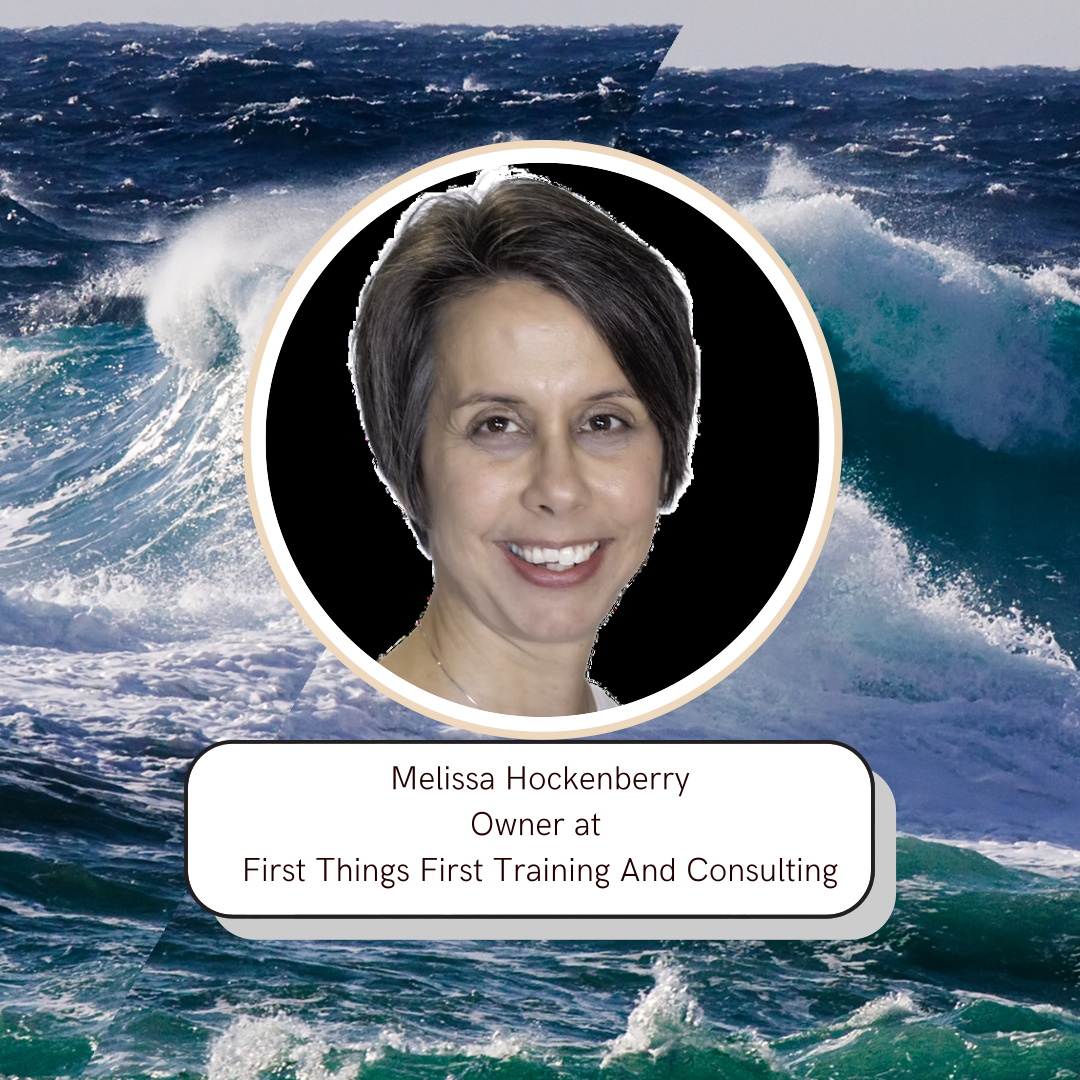
In this episode of MSP Mastery: Ctrl Alt Deliver, Nick and I explored a topic that every MSP owner says matters, but far too few treat with the discipline it deserves. Client retention is not luck. It is not personality. It is not something that sits with sales, or service, or finance in isolation. It is a whole of business leadership issue. Over 30 years of building and scaling MSPs, we have seen the same pattern repeat itself. The businesses that retain strong clients over the long term are not simply better at fixing technology. They are better at creating trust, reducing friction, setting expectations, and staying close to the commercial reality of the client relationship. The MSPs that struggle tend to drift. They assume silence means satisfaction. They rely on legacy arrangements. They lose touch with what it is actually like to do business with them. That is why this episode with Melissa Hockenberry was so valuable. Melissa brought a clear and practical perspective shaped by more than 20 years in the channel. Her experience strongly reinforced what we have coached for years. Retention is intentional. It has to be owned. And if you want clients to stay, your business must make it easy for them to trust you.
MSP Mastery
5/16/20266 min read
Client retention starts long before a client thinks about leaving
In this episode of MSP Mastery: Ctrl Alt Deliver, Nick and I explored a topic that every MSP owner says matters, but far too few treat with the discipline it deserves. Client retention is not luck. It is not personality. It is not something that sits with sales, or service, or finance in isolation. It is a whole of business leadership issue.
Over 30 years of building and scaling MSPs, we have seen the same pattern repeat itself. The businesses that retain strong clients over the long term are not simply better at fixing technology. They are better at creating trust, reducing friction, setting expectations, and staying close to the commercial reality of the client relationship. The MSPs that struggle tend to drift. They assume silence means satisfaction. They rely on legacy arrangements. They lose touch with what it is actually like to do business with them.
That is why this episode with Melissa Hockenberry was so valuable. Melissa brought a clear and practical perspective shaped by more than 20 years in the channel. Her experience strongly reinforced what we have coached for years. Retention is intentional. It has to be owned. And if you want clients to stay, your business must make it easy for them to trust you.
Retention is a leadership system, not a service desk metric
Strong retention comes from intentional ownership
One of the biggest mistakes we see in MSPs is that retention is treated as everybody’s job, which in practice means it becomes nobody’s job. When that happens, contract value slips, communication becomes inconsistent, and the warning signs are missed until a client gives notice.
Nick has long argued that every managed services agreement needs clear accountability at a senior level. Someone must own the health of the relationship, the profitability of the contract, the expectations on both sides, and the future opportunity within the account. That ownership cannot be vague. It cannot be spread across half a dozen people with no single point of responsibility.
Melissa backed this up beautifully in this episode. She made the point that MSPs are built on recurring revenue, yet many still have no person specifically focused on maintaining that revenue. That observation should stop every owner in their tracks. If recurring revenue is the engine of your business, then protecting it should never be left to chance.
For MSP owners, the lesson is simple. Do not confuse operational activity with relationship management. Fast ticket closure and neat reports are useful, but they are not proof of trust. Retention improves when a leader is intentionally watching the relationship and acting before small issues become commercial problems.
The easiest way to lose a client is to stop talking to them
Silence is not the same as satisfaction
One of the most dangerous assumptions in service delivery is that no complaints means everything is fine. We have seen this firsthand in our own businesses and across the MSPs we coach. A client can receive acceptable support and still quietly decide that you no longer understand their business, no longer value the relationship, or no longer feel essential.
That theme came through clearly in this episode. Melissa spoke about the need to stay connected to the client’s business, not just their technology. She challenged the idea that an MSP should throw its hands up when a client is acquired, under financial pressure, or facing major change. Her view, which aligns strongly with ours, is that if you are genuinely embedded in the client relationship, you should have some line of sight into those changes and some opportunity to add value around them.
This is where mature MSPs separate themselves from reactive ones. They do not wait for the quarterly review to discover that a client is unhappy, restructuring, or considering alternatives. They are already having the conversations that matter. They know the owner, the decision makers, and the commercial pressures shaping the client’s world.
This episode reinforced a principle we teach often. If you want better retention, get closer to the business problem. Ask better questions. Understand where the client is growing, where they are under pressure, and where they may need support outside pure technology. Trusted advisers are rarely replaced without warning. Anonymous providers often are.
Put on the client goggles
Experience your own business as a buyer would
One of the strongest practical lessons from this episode was Melissa’s idea of putting on the client goggles. We love that phrase because it captures something many owners forget once their business grows. The system you designed years ago is not necessarily the experience your client receives today.
Nick often challenges MSP owners to order something from their own company, ring their own help desk, or walk through an after hours process as if they were a new client. The answers can be confronting. Delays appear. Hand offs feel clumsy. Messaging becomes unclear. Internal assumptions that make sense to your team create confusion for the client.
Melissa pushed this even further with a practical suggestion. Ask someone outside the business to test the process. Get them to request a laptop, ask for a contract, ring support, or enquire about a service. Then watch what happens. That is not a gimmick. It is one of the fastest ways to expose friction.
This matters because friction erodes trust. Clients do not usually leave over one dramatic event. More often, they leave after a long series of small disappointments. A call that goes nowhere. A process that feels harder than it should. An expectation that was never set properly. A task that requires too much effort on their side.
For MSP owners, this is the hero moment from this episode. If you do one thing after reading this, go and experience your own service. Do it honestly. Do it without defending the outcome. Then ask why the team could not deliver the experience you thought they were delivering. That question leads to real improvement.
Retention begins inside the business
Internal client experience shapes external client loyalty
Another lesson we have learned over decades is that you cannot build a high trust client experience on top of a poor internal culture. If your team feels unsupported, ignored, or forced to carry the weight of difficult clients without leadership backing them, that strain always reaches the client eventually.
Melissa made this point powerfully when she linked external retention to internal retention. We could not agree more. Great service businesses understand that the team is the first client. If your people do not feel safe, clear, and valued, they will struggle to create that same experience for customers.
We saw this in our own MSP. When we exited clients who were a poor fit or who treated our team badly, the energy inside the business shifted immediately. People felt protected. Standards became real. Culture strengthened because leadership had acted.
This is not just a people issue. It is a commercial issue. Poor fit clients create stress, inconsistency, and hidden cost. They distract your leaders, frustrate your service team, and often sit on old agreements that no longer support profitability or strategic direction. Keeping them out of fear usually costs more than letting them go with a plan.
This episode validated something we tell MSP owners often. Sometimes the best retention strategy is better client selection. Not every client should stay. Mature MSPs know when to reset expectations, when to redesign the relationship, and when to set a client free to find a more suitable fit.
Growth comes from expectation setting and commercial courage
The best MSPs make relationships easier, not more complicated
As MSPs grow, complexity increases. More services, more stakeholders, more process, more risk. In that environment, clarity becomes a competitive advantage. Clients stay when they know what to expect, understand how to work with you, and can see that your recommendations are grounded in their success rather than your convenience.
Melissa touched on this several times throughout the conversation. Whether discussing acquisitions, AI, service friction, or account management, her message was consistent. Education matters. Expectation setting matters. Curiosity matters. Humility matters. Those are not soft ideas. They are operating principles for profitable, scalable service delivery.
For us, that is the key takeaway from this episode. Retention is not about trying harder to be liked. It is about building an MSP that clients can rely on. That means clear communication, strong accountability, deliberate relationship management, and the courage to address poor fit arrangements before they damage the wider business.
Final thoughts
This episode of MSP Mastery: Ctrl Alt Deliver was a timely reminder that client retention is built through hundreds of intentional decisions, not one grand strategy. Nick and I have seen over many years that the best MSPs do the simple things exceptionally well. They stay close to their clients. They remove friction. They protect their team. They review their own experience honestly. And they make someone accountable for the health of recurring revenue.
Melissa’s stories and observations gave real world proof to those principles. Her perspective supported what we know to be true. When an MSP leads with curiosity, communicates clearly, and takes ownership of the full relationship, retention becomes far more predictable.
If this episode made you reflect on where friction might be hiding in your own business, that is a good place to start. Take a fresh look at your client experience, your internal culture, and your ownership of recurring revenue. If you want to talk through what that could look like in your MSP, reach out to Nick, me, and the MSP Mastery team. We would love to keep the conversation going.