Scaling Beyond the Core: The Reality of Building and Selling an MSP Side Hustle
Every seasoned MSP owner has had that midnight moment of clarity. You are staring at your service desk metrics or watching your engineers wrestle with a repetitive, frustrating task and you think: there has to be a better way to do this. Over our thirty years of building, scaling, and eventually exiting Australian MSPs, Nick and I have lost count of the number of times we sat around a whiteboard mapping out custom software solutions. In the early days, before the industry had mature, off-the-shelf tools, we built our own internal platforms because we simply had to. We wrote operational systems, time-sheet trackers that ran on floppy disks, and even complex database reporting tools using Microsoft Access and Lotus Notes. However, there is a massive gulf between writing code to solve an internal operational bottleneck and building a commercial, scalable software-as-a-service business. Most MSP owners who venture down the software path find themselves trapped in a classic dilemma: they cannibalise their core business profits to fund a product that never quite makes it to market. To explore this delicate balance, we recently welcomed back a good friend and exceptional operator to our podcast, MSP Mastery: Ctrl Alt Deliver. Tas Gray, the founder of Axiom IT, joined us to share his incredible journey of building, scaling, and ultimately selling his cloud-management SaaS product, MSP Magic. Tas is a software developer by trade who pivoted into the MSP space thirteen years ago, but his passion for automation and smart systems never left him. His story serves as the perfect case study for how to turn a technical solution into a highly desirable commercial asset, while highlighting the extreme operational pressures that come with running two distinct companies simultaneously.
MSP Mastery
6/22/20266 min read
Every seasoned MSP owner has had that midnight moment of clarity. You are staring at your service desk metrics or watching your engineers wrestle with a repetitive, frustrating task and you think: there has to be a better way to do this. Over our thirty years of building, scaling, and eventually exiting Australian MSPs, Nick and I have lost count of the number of times we sat around a whiteboard mapping out custom software solutions. In the early days, before the industry had mature, off-the-shelf tools, we built our own internal platforms because we simply had to. We wrote operational systems, time-sheet trackers that ran on floppy disks, and even complex database reporting tools using Microsoft Access and Lotus Notes.
However, there is a massive gulf between writing code to solve an internal operational bottleneck and building a commercial, scalable software-as-a-service business. Most MSP owners who venture down the software path find themselves trapped in a classic dilemma: they cannibalise their core business profits to fund a product that never quite makes it to market.
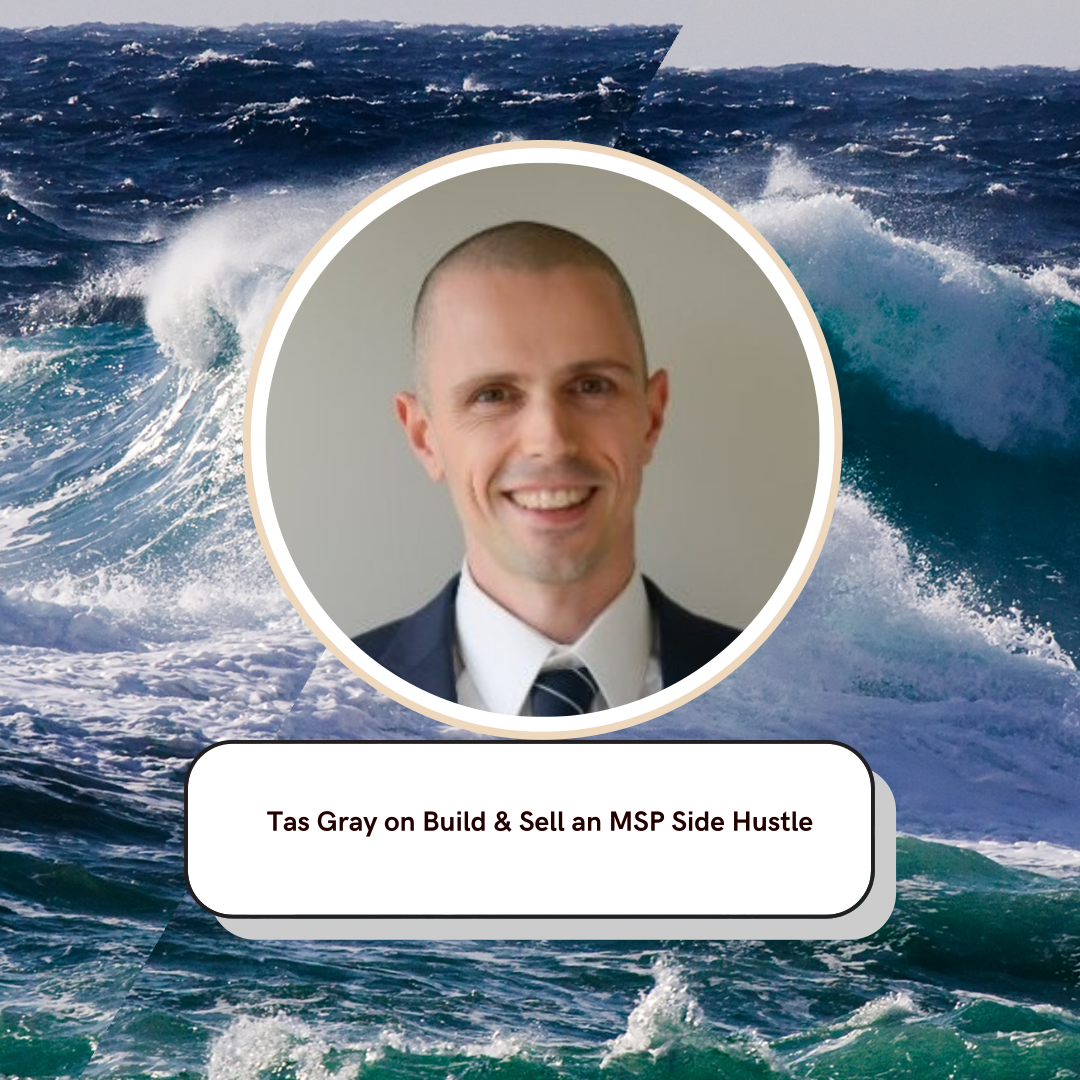
To explore this delicate balance, we recently welcomed back a good friend and exceptional operator to our podcast, MSP Mastery: Ctrl Alt Deliver. Tas Gray, the founder of Axiom IT, joined us to share his incredible journey of building, scaling, and ultimately selling his cloud-management SaaS product, MSP Magic. Tas is a software developer by trade who pivoted into the MSP space thirteen years ago, but his passion for automation and smart systems never left him. His story serves as the perfect case study for how to turn a technical solution into a highly desirable commercial asset, while highlighting the extreme operational pressures that come with running two distinct companies simultaneously.
The Second Wave and the Birth of a Product
Our perspective has always been that true operational efficiency is born out of structural shifts in technology. When Nick and I were scaling our MSP, the big shifts revolved around active directory, group policy, and physical imaging. We built incredibly sophisticated automated deployment pipelines using PXE booting and network deployment.
But as the cloud took over, those legacy methodologies began to fade. Tas’s journey with MSP Magic started during what we call the second wave of the Microsoft Cloud around 2018. This was the moment Microsoft rebranded Office 365 to Microsoft 365 and introduced the Business Premium licence, which bundled Azure Active Directory and Intune together. Suddenly, MSPs had the capability to push security configurations and manage corporate endpoints directly from the cloud without needing expensive, on-premises domain controllers.
While the capability was revolutionary, the management experience was a nightmare. Microsoft did not build these tools with multi-tenant MSP architectures in mind. Every single client tenant had to be configured and managed individually. Recognising this massive gap, Tas decided to build a clean graphical front-end that wrapped around Microsoft’s backend APIs, allowing automated, multi-tenant policy deployment.
The critical distinction in Tas’s approach, and one we highly commend, is that he did not treat this as a minor internal project. From day one, he established MSP Magic as a completely separate legal and financial entity, brought in an external business partner, and designed the software to be a generalised, commercial product. Too often, MSP owners build internal code that is so deeply hardcoded to their own processes that it can never be sold to a competitor. If you want to build a software asset, you must detach it from your service delivery engine from the very beginning.
The Reality of Funding, Risk, and Market Adoption
One of the greatest illusions of the software world is that a great product automatically leads to a stress-free business. When Tas launched MSP Magic, the market adoption was immediate. By simply launching a basic website and engaging directly with peers on platforms like Reddit, global leads began flowing in. In the SaaS world, solving a painful, highly specific problem can make sales feel almost effortless compared to the relationship-heavy, long-cycle sales process of an MSP.
However, behind the scenes, the financial and operational strain was mounting. Even when a software company is structured separately, the financial risk does not vanish. Throughout our business journey, Nick and I have seen the dangers of cross-funding ventures. We once poured substantial profits from our MSP into developing a complex project management tool, only to watch it struggle because we lacked a dedicated software sales structure.
Tas managed to keep MSP Magic financially stable, but he quickly encountered a classic technology risk: the sudden arrival of competitors. Almost overnight, the market went from a blue ocean to being crowded with heavily funded competitors and free, open-source alternatives. When you are self-funding a software business from your own resources, competing against venture-backed startups or free community tools places an immense burden on your development pipeline. This rapid escalation meant that to keep MSP Magic ahead of the pack, a massive injection of capital was required. When global venture capital began to dry up, Tas had to make a hard strategic choice: secure the future of the product through an acquisition, or risk watching the window of opportunity slide away.
The Maltese Backups and the Melbourne Dinners
Every business owner dreaming of an exit wonders what a successful acquisition actually looks like. Many are terrified of the infamous golden handcuffs, where founders are locked into brutal performance targets and complex earn-out structures that drag on for years, sometimes ending in legal disputes.
The turning point for MSP Magic came when European cloud security giant Hornet Security identified the platform as the perfect piece to fill their multi-tenant management gap. When we break down why this acquisition succeeded, it comes down to a deep alignment of values, culture, and mutual trust rather than just legal contracts.
Hornet Security’s chief executive officer personally flew out to Melbourne and spent an entire week with Tas, going out to dinners, sharing stories, and introducing their broader leadership team over digital channels. Furthermore, Tas was able to perform due diligence on the buyer by speaking directly with founders of previous companies Hornet had acquired, such as a backup software team based in Malta who were still happily working inside the broader corporate group years later.
This is a vital lesson for any MSP owner contemplating a sale or merger. Contracts and lawyers are necessary, but they cannot protect you from a buyer who does not align with your character. A successful exit requires open, transparent communication, a shared vision for the product’s future, and a genuine relationship built over face-to-face conversations. Because of this alignment, Tas was able to secure a highly clean, favorable exit with no painful lock-in agreements, allowing Hornet Security to take the product to the global stage while he stepped back.
The Executive Decompression and Future Horizons
There is a hidden cost to running a side hustle that very few people talk about openly. For over three years, Tas was balancing the strategic leadership of Axiom IT with the intense, rapid-fire demands of a scaling global software startup. He admits that this period of sustained high stress probably took ten years off his life. Running two businesses means your mind is permanently divided, your cortisol levels remain unhealthily elevated, and your personal life is pushed to the absolute margin.
Since completing the sale, Tas has spent the last couple of years deliberately decompressing, focusing on his family, and enjoying a slower pace of life. It is a transition that Nick and I understand deeply. When you have spent decades as the primary driver of a business, your company becomes a core part of your personal identity. Pulling yourself away from that daily adrenaline rush requires significant soul-searching and a willingness to simply watch from the sidelines for a while.
Today, while Tas keeps a keen eye on the rapid, exciting developments in the artificial intelligence space, he is enjoying the luxury of not being busy seven days a week. The MSP landscape is changing faster than ever, and while the temptation to build the next great AI-driven service desk tool is always there, there is immense wisdom in staying on the sideline, observing, and letting the initial dust settle before jumping back into the arena.
Forging Your Own Path to Mastery
Building a software product alongside an active MSP is one of the most challenging paths an entrepreneur can take. If there is one definitive piece of advice that Tas shares from his journey, it is the necessity of absolute commitment. If you want a side venture to truly succeed, you must eventually remove yourself from the daily operations of your core MSP. You cannot treat a global software play as a part-time hobby; it must become your main game, supported by a strong leadership team running your service delivery engine in the background.
We want to thank Tas Gray for his incredible openness and for sharing the practical reality of what it takes to build, scale, and exit a technology asset. His achievement is a testament to what smart automation and disciplined business design can produce.
If this discussion has sparked some ideas about your own operational maturity, or if you are currently wrestling with the balance of scaling your service delivery while exploring new opportunities, we would love to hear from you. Head over to our website to explore more insights, and reach out to Nick, myself, and the team to keep this conversation going.