The AI Roadmap MSPs Actually Need: Moving Beyond the Hype to Real Business Value
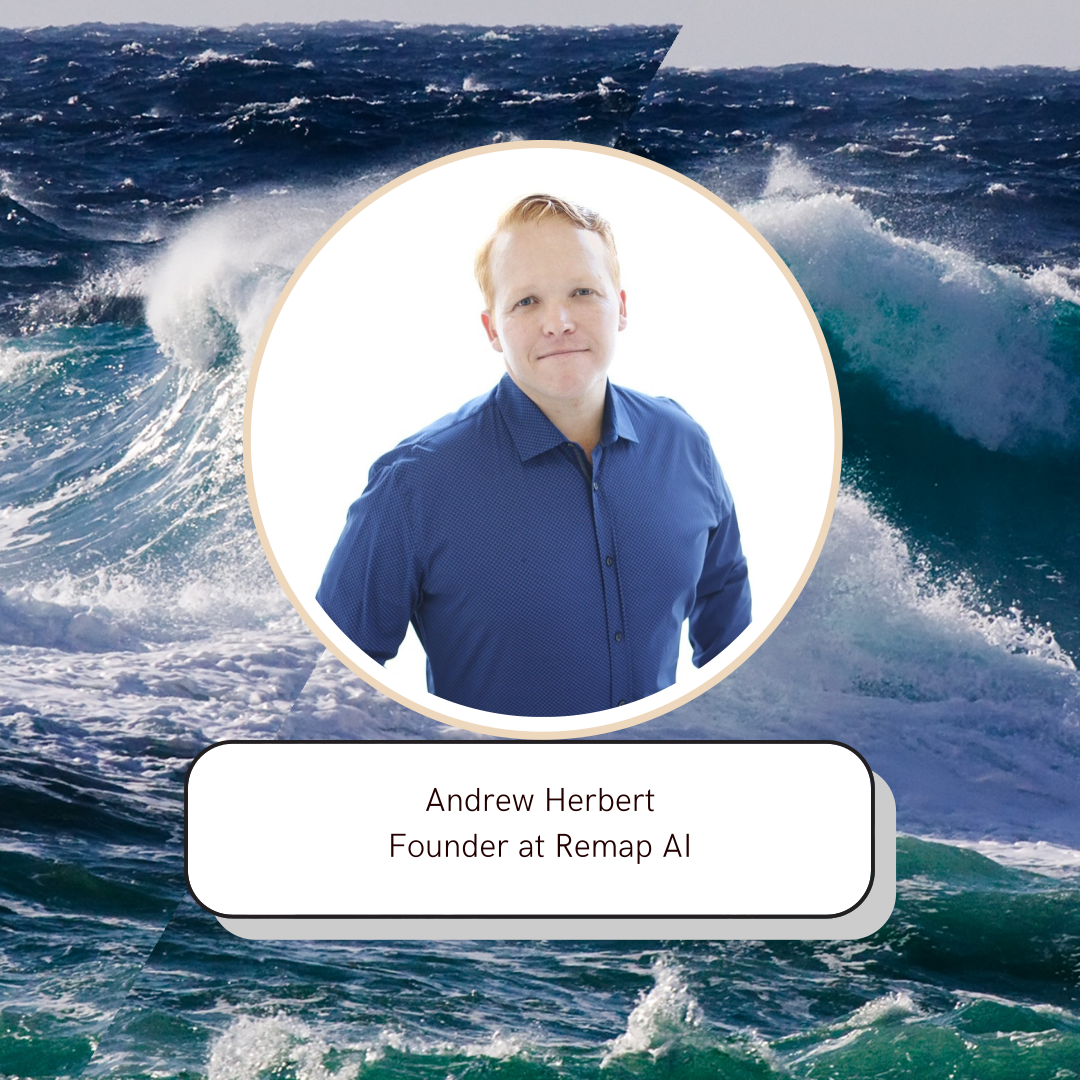
After 30 years building and scaling MSPs across Australia, Nick and I have seen every technology wave promise to revolutionise service delivery. From cloud migrations to automation platforms, we've watched MSP owners chase shiny tools that add complexity instead of solving problems. Artificial intelligence is the latest frontier, and the questions flooding our inbox tell us one thing: MSP owners know their clients are asking about AI, but they're not sure where to start or how to position themselves as trusted advisors in this space. This episode, we sat down with Andrew Herbert, founder of Remap AI and a fellow Bali resident who's spent the last several years helping businesses cut through AI hype to find practical automation solutions. Andrew's journey from defence and property investment to AI consulting mirrors what we've always believed: the best technology serves the business, not the other way around. His experience reinforces the frameworks Nick and I have developed over three decades, particularly around incremental change, staff engagement, and building systems that actually save time.
MSP Mastery
5/18/20266 min read
The AI Roadmap MSPs Actually Need: Moving Beyond the Hype to Real Business Value
After 30 years building and scaling MSPs across Australia, Nick and I have seen every technology wave promise to revolutionise service delivery. From cloud migrations to automation platforms, we've watched MSP owners chase shiny tools that add complexity instead of solving problems. Artificial intelligence is the latest frontier, and the questions flooding our inbox tell us one thing: MSP owners know their clients are asking about AI, but they're not sure where to start or how to position themselves as trusted advisors in this space.
This episode, we sat down with Andrew Herbert, founder of Remap AI and a fellow Bali resident who's spent the last several years helping businesses cut through AI hype to find practical automation solutions. Andrew's journey from defence and property investment to AI consulting mirrors what we've always believed: the best technology serves the business, not the other way around. His experience reinforces the frameworks Nick and I have developed over three decades, particularly around incremental change, staff engagement, and building systems that actually save time.
The Three Pillars: Understanding Where AI Fits in Your Service Stack
One of the biggest mistakes we see MSPs make is treating AI as a single solution rather than a spectrum of tools. Andrew's framework aligns perfectly with how we've always approached technology deployment: start simple, prove value, then scale.
The first pillar is off the shelf solutions. These are the meeting note takers, the single purpose tools that require minimal configuration. They're low cost, quick to deploy, but limited in scope. For MSPs testing the waters with AI, this is your entry point. The second pillar sits at the opposite end: custom AI applications. These are expensive, time consuming, and more complex than you'll anticipate. Unless you're building genuine IP or creating measurable competitive differentiation, this isn't where most MSPs should focus their energy.
The sweet spot, and where Nick and I see the most opportunity for MSPs, is the middle pillar: automation and agentic AI. This is where you chain together off the shelf solutions or connect existing systems to create workflows that solve real business problems. Andrew shared a perfect example: an email arrives with an invoice attached, the system extracts the data, and loads it directly into Xero. No AI required for the basic version, but add an AI model in the middle to verify it's actually a bill and you've got quality control built in.
What Andrew calls AI augmented automation is exactly what we've been advocating for years in service delivery: take manual, repetitive tasks and systematise them. The difference now is that AI gives you decision making capability in the middle of those workflows, not just simple if this then that logic.
The One Percent Rule: Why Incremental Wins Beat Big Bang Deployments
James Clear's concept of one percent incremental change has been a cornerstone of how Nick and I have scaled MSPs. Twenty small wins compound faster than one massive transformation, and they create far less organisational resistance. Andrew's approach to AI deployment follows this exact philosophy, and his reasoning reinforces what we've learned the hard way over 30 years.
When you bring in a massive shift, like deploying a fully autonomous AI agent across an organisation, you trigger fear. Staff see job threats. Processes break. Resistance builds. But when you automate the task of reading an email and filing a bill into Xero, nobody's threatened. Everyone's relieved. That's the friction point removal that builds momentum.
Andrew calls them friction points, those manual tasks that frustrate your team and waste time. We've always called them pain points, but the principle is identical: identify them, prioritise them, and systematically eliminate them. The key is engaging your staff in the process. Innovation isn't something you schedule once a month in a strategy session. It's an underlying attitude where everyone in the organisation is empowered to identify problems and suggest solutions.
Nick and I have run this play dozens of times. Get your team to write down every manual task they hate. Capture it in a form, a spreadsheet, even Post It notes on a wall. Then prioritise using what Andrew calls an impact effort matrix. Plot each friction point based on two factors: how much is this costing us in time and money, and how hard would it be to train someone to do this task.
The quadrant that emerges tells you exactly where to start. High impact, low effort? Those are your quick wins. Go after them first. Low impact, low effort? Still worth doing because they build confidence and momentum. High effort, low impact? Defer them. High impact, high effort? Schedule them for later once you've built the infrastructure and capability.
The MSP Opportunity: Preparing Clients for an Agentic Future
Here's where the conversation gets practical for MSPs. Your clients are asking about AI, but they're not ready for it. Not because the technology isn't there, but because their data architecture is a mess. Nick raised this exact point during the episode, and Andrew's response validated what we've been telling MSP owners for years: before you can deploy intelligent automation, you need structured data.
Most businesses treat their Google Drive or OneDrive like a dumping ground. Files get saved with random names, no folder hierarchy, no metadata, no naming conventions. Humans can search and find what they need, but AI agents can't make sense of chaos. The MSP opportunity right now isn't selling AI tools. It's preparing clients to be AI ready.
That means auditing their data architecture. Do they have consistent naming conventions? Are files organised logically? Are there metadata tags that help systems understand what each document contains? This is foundational work that MSPs are perfectly positioned to deliver, and it's billable work that sets the stage for every AI deployment that follows.
Andrew mentioned that his team focuses on creating structure out of chaos, and that's exactly the value MSPs should be providing. You're not building custom AI applications. You're ensuring that when the right tool or agent comes along, your client's environment is ready to take advantage of it.
The Security and Compliance Reality Check
One area where Andrew's expertise reinforced our long standing position is around security and data sovereignty. If you're deploying AI solutions for clients, particularly in regulated industries like finance, healthcare, or government, you need to understand where data is going, who's processing it, and what compliance frameworks apply.
Free AI tools are training on your data. That's the business model. If your clients are using free ChatGPT accounts to process customer information, they're likely breaching their own compliance obligations. Paid accounts offer better protections, but even then, you need to understand retention policies, data sovereignty requirements, and who has access to logs.
Andrew's point about third party influence was particularly relevant. Even if a platform promises not to retain your data, external legal requirements can override those commitments. We've seen this play out in cloud migrations, and it's no different with AI. MSPs need to ask the hard questions: where is the model hosted, who controls it, and what happens to the data after processing?
For clients with strict compliance requirements, the answer might be hosting your own models or using secure, compliant environments. This isn't a conversation most MSPs are having yet, but it's one you need to be prepared for. Your role as a trusted advisor means protecting your clients from risks they don't even know exist.
Moving Forward: Building Your AI Capability Without Losing Your Mind
The AI landscape changes monthly. Andrew mentioned waking up with whiplash from the pace of updates, and Nick spends 20 hours a week just keeping up. That's not sustainable for most MSP owners, and it's not necessary. What you need is a framework, not expertise in every new tool that drops.
Start by engaging your team and your clients in identifying friction points. Use an impact effort matrix to prioritise. Focus on automation and connecting existing systems before chasing custom AI applications. Prepare your clients' data architecture so they're ready when the right opportunity emerges. And always, always ask the security and compliance questions before deploying anything.
The MSPs that thrive in the AI era won't be the ones chasing every new model release. They'll be the ones who understand their clients' businesses deeply enough to identify where intelligent automation creates real value, and who have the discipline to implement incrementally rather than chasing big bang transformations.
If this conversation has you thinking about how to position your MSP in the AI space, or if you're wrestling with where to start with your own operations, reach out. Nick and I have spent three decades helping MSP owners build businesses that work for them, not the other way around. The technology changes, but the principles of good service delivery remain constant.