The Power of the Virtual Hug: Mastering Service Delivery with Aaron Lake
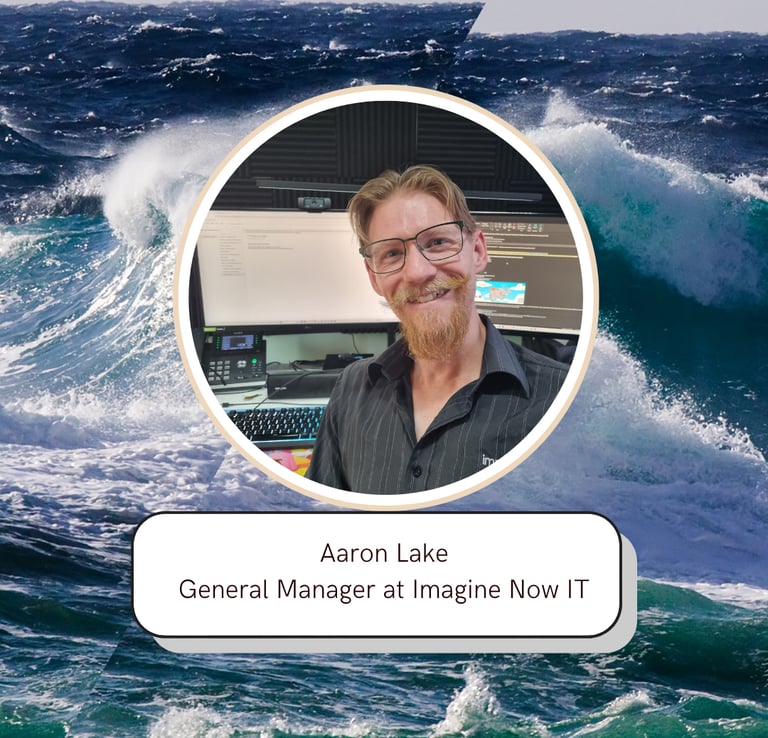
In the world of Managed Service Providers, we often get caught up in the technical weeds. We talk about disk IO, API integrations, and the latest cybersecurity threats. But after 30 years of building and scaling Australian MSPs, Nick and I have learned that the most sophisticated technology in the world cannot replace the fundamental human element of service delivery. If you cannot connect with the person on the other end of the phone, your technical brilliance is essentially wasted. In this episode of MSP Mastery: Ctrl Alt Deliver, we sat down with Aaron Lake, General Manager at Imagine Now IT. Aaron has been a part of the industry since 2003, and his journey from a small computer shop to leading a mature MSP reflects many of the patterns we have observed over three decades. His perspective reinforces a core MSP Mastery framework: technical excellence is the baseline, but emotional intelligence is the multiplier.
MSP Mastery
4/9/20265 min read
The Power of the Virtual Hug: Mastering Service Delivery with Aaron Lake
In the world of Managed Service Providers, we often get caught up in the technical weeds. We talk about disk IO, API integrations, and the latest cybersecurity threats. But after 30 years of building and scaling Australian MSPs, Nick and I have learned that the most sophisticated technology in the world cannot replace the fundamental human element of service delivery. If you cannot connect with the person on the other end of the phone, your technical brilliance is essentially wasted.
In this episode of MSP Mastery: Ctrl Alt Deliver, we sat down with Aaron Lake, General Manager at Imagine Now IT. Aaron has been a part of the industry since 2003, and his journey from a small computer shop to leading a mature MSP reflects many of the patterns we have observed over three decades. His perspective reinforces a core MSP Mastery framework: technical excellence is the baseline, but emotional intelligence is the multiplier.
The Framework of the Virtual Hug
One of the most significant challenges for MSP owners is teaching technical staff how to handle high pressure client interactions. When a client calls because their systems are down or their staff are sitting idle, they are not just reporting a ticket. They are experiencing a business disruption that carries real financial and emotional weight.
Aaron described what he calls the virtual hug, and it is one of the clearest expressions we have seen of what great service delivery looks like in practice. The idea is simple. Before solving the problem, you must acknowledge the person. You must listen fully, allow the client to explain their situation, and then respond with confidence and calm.
This aligns directly with what we have coached MSP teams on for years. Engineers are wired to jump ahead. They hear a few keywords and immediately move into fix mode. But when you interrupt or rush, the client feels dismissed. Even if the issue is resolved quickly, the experience feels poor.
The virtual hug closes that gap. It reassures the client that they are heard and that the situation is under control. That moment of connection is what builds trust, not just the technical outcome.
From Technician to Leader
We see this time and time again. The best technicians are often the ones promoted into leadership, yet many resist the move. Aaron openly shared that he avoided stepping into a general manager role for years because he did not think he would enjoy leaving the technical work behind.
This is a critical inflection point in any MSP. You cannot scale if your senior people remain stuck in delivery. At some stage, you have to shift from doing the work to enabling others to do it.
Aaron’s experience highlights an important reality. What makes you successful as a technician does not automatically make you successful as a leader. As a technician, you focus on solving problems. As a leader, you focus on creating clarity, structure, and direction.
Nick and I have seen many MSPs stall because the owner remains the escalation point for everything. If you are still the one jumping in at all hours to fix issues, you do not have a scalable business. You have a dependency.
The shift to leadership is about building a system where the business runs without you being the safety net for every failure.
Why Structure Sets Your Team Up to Succeed
One of the strongest themes from this episode was the importance of structure. Aaron spoke about how, if he were starting again, he would implement policies, procedures, and clear expectations from day one.
This is something we strongly agree with. There is a common misconception that hiring smart people is enough. It is not. Without structure, even the best people will struggle.
Employees do not think like business owners. They are not naturally considering travel efficiency, cost control, or the broader operational impact of their decisions. That is not a flaw. It is simply a different role.
It is your responsibility as a leader to provide the framework they operate within.
We have seen this play out in simple but costly ways. A technician arrives onsite without the required hardware because no one clearly confirmed what was needed. Another starts their day without clarity on priorities, wasting valuable time.
These are not capability issues. They are clarity issues.
When you introduce structure, clear instructions, and accountability, performance improves rapidly. Not because your team changed, but because the environment did.
The Reality of Disaster and Why Preparation Matters
Every MSP has a story that reinforces the importance of doing the fundamentals well. In this episode, Aaron shared a case where a client was hit by ransomware across multiple servers after a user clicked a malicious link.
What stood out was not just the incident itself, but how it was detected and handled. Monitoring systems flagged abnormal disk activity, allowing the team to respond quickly. From there, it came down to having a robust backup strategy in place.
This is where experience matters. We have seen countless MSPs struggle to sell backup solutions because clients view them as an unnecessary cost. That is, until something goes wrong.
After a full recovery, that conversation disappears. The value becomes obvious.
The lesson for MSP owners is clear. You are not there to sell what is easy. You are there to protect your clients from risk. That requires conviction, even when the client pushes back.
Communication Builds Trust Faster Than Perfection
Another key insight reinforced in this episode is the importance of transparency. Mistakes happen. Systems fail. People click links they should not.
What matters is how you respond.
In our experience, you will lose a client faster by hiding a mistake than by owning one. When you communicate early, take responsibility, and clearly outline the path forward, you build trust even in difficult situations.
Aaron made the point that honesty can come at a short term cost, but it builds long term respect. We have seen that play out time and time again.
Trust is not built when everything goes right. It is built in how you handle things when they go wrong.
The Hero Moment and What It Really Teaches
The ransomware incident in this episode is a classic hero moment. Multiple servers encrypted, business operations at risk, and a team forced to respond under pressure.
But the real value is not in the drama of the recovery. It is in what enabled that recovery.
The monitoring that detected the issue. The backup systems that were in place. The team that knew how to respond. The leadership that ensured the right investments had been made before the crisis occurred.
Too often, MSPs focus on the firefighting moment. What matters more is the preparation that made success possible.
That is the difference between luck and operational maturity.
Conclusion
This episode reinforces a pattern we have seen across decades in the MSP industry. Success is not built on technical skill alone. It is built on communication, structure, and leadership.
The virtual hug reminds us that service delivery is human first. Structure reminds us that teams need clarity to perform. And real world incidents remind us that preparation is everything.
If you can bring these elements together, you create a business that delivers consistently, builds trust, and scales effectively.
Take a moment to reflect on your own MSP. Are your clients feeling heard, or just serviced. Is your team operating with clarity, or relying on guesswork. Are you building systems that prevent problems, or just reacting to them.
If you are ready to lift your service delivery maturity and build a stronger, more scalable MSP, connect with Nick, myself, and the MSP Mastery team. We are always up for a conversation about what better looks like.