Unlocking Scalable Growth: Why the Hero Sales Model is Killing Your MSP
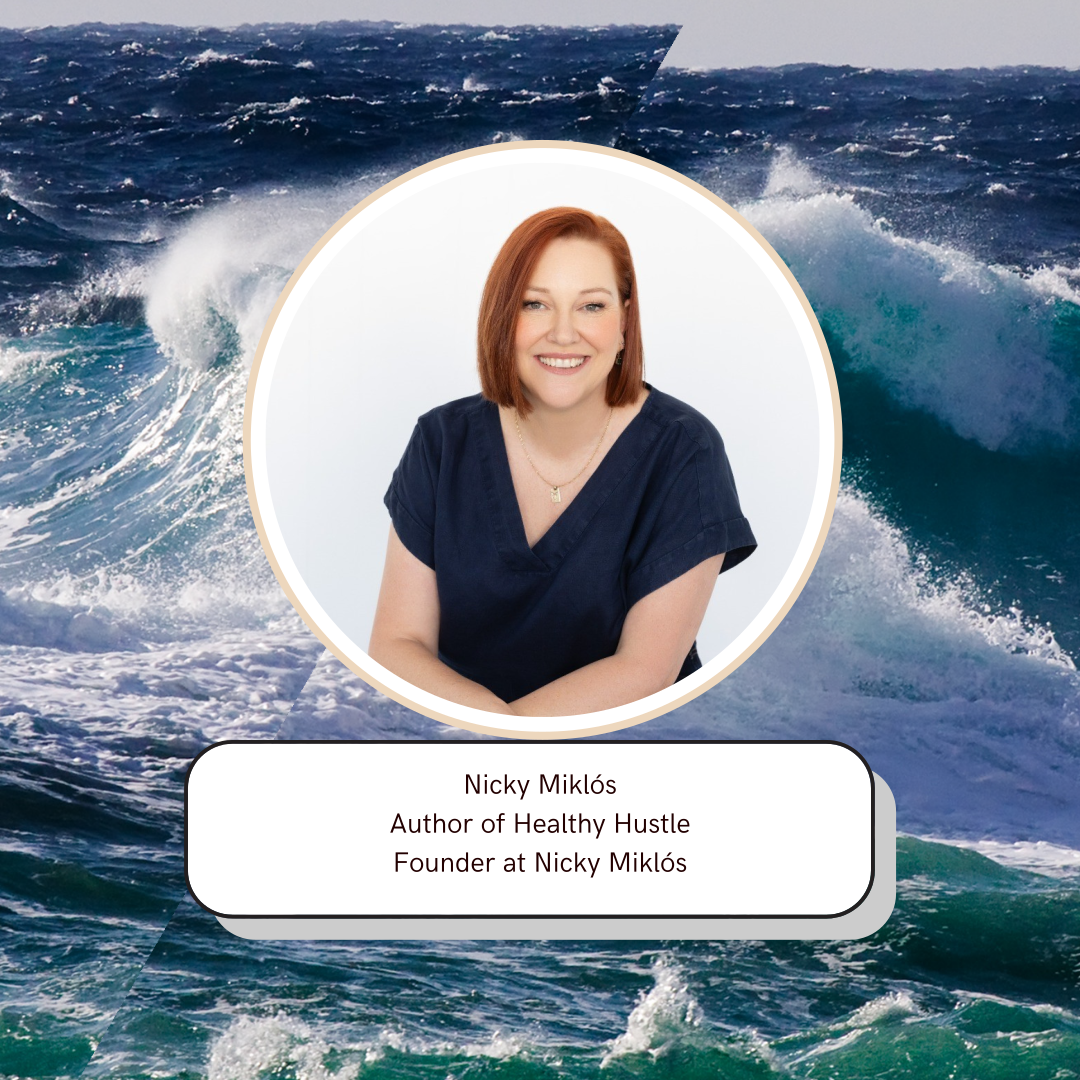
Over our thirty years of building, scaling, and successfully exiting IT businesses in Australia, Nick Clift and I have noticed a persistent and frustrating pattern. Many managed service providers reach a certain size, typically around the one to three million dollar revenue mark, and then hit an invisible ceiling. The operational gears are turning, the technical team is delivering good work, but the sales engine feels entirely dependent on the business owner or a single high-performing individual. This reliance on a solo operator is a high-risk strategy that ultimately caps your business value, limits your freedom, and leads to severe leadership burnout. We have always maintained that a mature service model requires shifting from individual heroics to robust, predictable systems. In this episode of MSP Mastery: Ctrl Alt Deliver, we sat down with sales leadership expert Nicky Miklos-Woodley to discuss how to break this dependency. Nicky is a peer who has worked closely with us, and her insights reinforce a long-standing truth we advocate for at MSP Mastery: sustainable growth is never the result of a single superstar, but rather the product of structured commercial leadership where everyone plays a role.
MSP Mastery
6/15/20265 min read
Over our thirty years of building, scaling, and successfully exiting IT businesses in Australia, Nick Clift and I have noticed a persistent and frustrating pattern. Many managed service providers reach a certain size, typically around the one to three million dollar revenue mark, and then hit an invisible ceiling. The operational gears are turning, the technical team is delivering good work, but the sales engine feels entirely dependent on the business owner or a single high-performing individual. This reliance on a solo operator is a high-risk strategy that ultimately caps your business value, limits your freedom, and leads to severe leadership burnout.
We have always maintained that a mature service model requires shifting from individual heroics to robust, predictable systems. In this episode of MSP Mastery: Ctrl Alt Deliver, we sat down with sales leadership expert Nicky Miklos-Woodley to discuss how to break this dependency. Nicky is a peer who has worked closely with us, and her insights reinforce a long-standing truth we advocate for at MSP Mastery: sustainable growth is never the result of a single superstar, but rather the product of structured commercial leadership where everyone plays a role.
The Illusion of the Sales Superhero
In the early stages of an MSP, the business owner is almost always the chief salesperson. Your passion, deep industry knowledge, and personal relationships are what win those crucial early contracts. However, as the business matures, relying on the owner or a newly appointed sales superhero to drive revenue becomes a significant operational bottleneck. When that single person is busy, sick, or simply focused on resolving a client emergency, the pipeline dries up immediately, throwing the business into a stressful cycle of feast or famine.
From our three decades of building Australian MSPs, we have seen that true business value only exists when revenue generation is detached from the owner. This requires establishing a clear sales methodology that can be easily learned and repeated by others. Nicky Miklos-Woodley validated this during our conversation, highlighting that many leaders fail to scale because they treat sales as an innate talent rather than a structured system. When you build a documented sales playbook, define clear activity benchmarks, and treat client acquisition as a standard operational workflow, you de-risk the business and lay the foundation for predictable quarterly growth.
Building Commercial Leadership and Team Accountability
Many managed service providers make the mistake of hiring a salesperson, throwing them some leads, and expecting them to succeed without any ongoing guidance or framework. Just as you would not leave a junior engineer to manage a complex cloud migration without supervision, you cannot leave your sales function to run on autopilot. Establishing a sales rhythm is just as critical as your technical escalation path or your service desk dispatch processes.
Our experience has taught us that commercial leadership requires a regular, structured cadence to maintain momentum. Nicky shared her framework during the episode, outlining how successful sales teams thrive on three core areas: documented processes, active coaching, and consistent team rhythms. This means moving away from ad-hoc catch-ups and instead implementing weekly sales huddles, review sessions, and clear activity metrics. When you establish these regular checkpoints, you create a culture of accountability where barriers are identified early, and the entire team understands exactly what is required to hit target.
Sales as a Multi-Disciplinary Team Sport
One of the most powerful mindset shifts an MSP owner can make is realizing that client acquisition and account growth should be a collaborative effort. Technical account managers, project engineers, and even service desk dispatchers often have the closest relationships with your clients and hear about training gaps, aging hardware, or security concerns first. If your organization operates in silos, those potential opportunities are regularly lost because the technical team does not see sales as part of their responsibility.
At our former MSP, DWM Solutions, we actively broke down these barriers by establishing a unified approach to growth. We implemented a balanced incentive program where fifty percent of the target was based on individual achievement, and fifty percent was tied to the overall team performance. This simple structural change encouraged our engineers and account managers to share leads and support one another rather than hoarding opportunities. Nicky noted that this collaborative model is precisely how mature MSPs unlock hidden margins, as it transforms every client touchpoint into an opportunity to add value and strengthen the business partnership.
Case Study: Driving Sales While on a Six-Week Holiday
The ultimate test of any business system is what happens when the business owners step away. Early in our journey, leaving the office for even a few days felt incredibly risky. However, after implementing a collaborative sales rhythm and empowering our team with clear accountability milestones, we decided to put our systems to the test by taking a six-week holiday.
Instead of returning to a stagnant pipeline or a backlog of client issues, we came back to find that the team had actually exceeded their sales targets in our absence. When we analyzed why this occurred, the answer lay in the shared incentive structure and the clear operational playbooks we had put in place. Because our team knew exactly how to qualify opportunities and run the sales process, and because the shared target kept everyone aligned, they did not need us there to close deals. This real-world lesson proved that when you stop trying to be the hero and instead focus on building a self-sustaining system, your business can thrive without your constant physical presence.
Prioritizing the Healthy Hustle and Radical Trust
Scaling a services business is undeniably demanding, but it should not come at the expense of your physical and mental well-being. Far too many MSP owners wear their eighty-hour work weeks like a badge of honor, failing to realize that chronic exhaustion impairs decision-making and trickles down to damage team culture. Sustainable leadership requires stepping back from the constant operational chaos to protect your own energy and focus on strategic direction.
A key part of maintaining this health and balance is building an environment of radical trust within your team. During the episode, we discussed how giving staff the flexibility to manage their own time, such as taking a break for a gym session during the day, actually yields a massive return in productivity and loyalty. If you feel the need to constantly monitor your team’s screens or micromanage their hours, there is a fundamental flaw in your hiring path or your organizational trust. When you build structured systems, define clear out-of-hours boundaries, and trust your people to deliver, you create a self-managing environment that allows you to work on the business rather than being permanently trapped in it.
Practical Steps for Your Practice
To move away from individual heroics and start building a predictable growth engine, we recommend that you focus on three immediate areas:
First, audit your current customer acquisition journey and document the steps required to take a prospect from an initial inquiry to a signed managed services agreement.
Second, establish a regular fifteen-minute weekly sales huddle with everyone involved in business development to review active opportunities, discuss pipeline blocks, and ensure alignment.
Third, look for ways to incentivize collaboration across your technical and commercial teams so that finding new ways to support and secure your clients becomes a shared goal.
Building a sustainable, high-value business is a journey that requires continuous reflection on both your processes and your leadership style. If you are ready to transition your MSP away from owner-dependent sales and build a reliable commercial system, we are here to help. Reach out to Jeni, Nick, and the MSP Mastery team today to discuss how we can support you in scaling your operations, improving your service delivery, and reclaiming your time.