What Karl Palachuk’s Story Confirms About Building an MSP that Can Actually Scale
One of the biggest traps MSP owners fall into is thinking growth will fix service delivery problems. Over the last 30 years, Nick and I have seen the opposite. If your customer experience is inconsistent at ten users, it will be chaotic at one hundred. If your team relies on heroics instead of process, more clients simply means more stress. And if your relationships are shallow, the moment you try to introduce something new, whether that is cloud, security, or AI, you will feel the resistance straight away. That is why this episode of MSP Mastery: Ctrl Alt Deliver with Karl Palachuk was such a strong conversation. Karl has been around the managed services world since the mid nineties, built and sold businesses himself, and spent years teaching MSPs how to move from reactive work into something more sustainable. What stood out to us was not that his story was unusual. It was that it confirmed so many lessons Nick and I have learned the hard way ourselves. Karl’s experience reinforces a truth MSP owners need to hear more often. Good service delivery is not built on tools first. It is built on trust, clear expectations, repeatable processes, and leadership that knows how to turn a service promise into a consistent client experience.
MSP Mastery
5/1/20267 min read
What Karl Palachuk’s story confirms about building an MSP that can actually scale
One of the biggest traps MSP owners fall into is thinking growth will fix service delivery problems. Over the last 30 years, Nick and I have seen the opposite. If your customer experience is inconsistent at ten users, it will be chaotic at one hundred. If your team relies on heroics instead of process, more clients simply means more stress. And if your relationships are shallow, the moment you try to introduce something new, whether that is cloud, security, or AI, you will feel the resistance straight away.
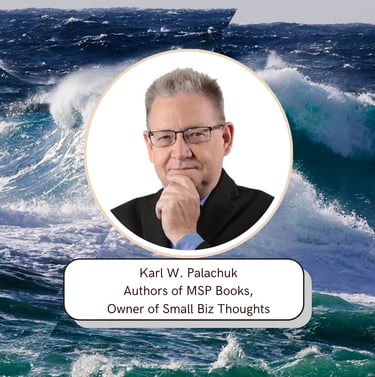
That is why this episode of MSP Mastery: Ctrl Alt Deliver with Karl Palachuk was such a strong conversation. Karl has been around the managed services world since the mid nineties, built and sold businesses himself, and spent years teaching MSPs how to move from reactive work into something more sustainable. What stood out to us was not that his story was unusual. It was that it confirmed so many lessons Nick and I have learned the hard way ourselves.
Karl’s experience reinforces a truth MSP owners need to hear more often. Good service delivery is not built on tools first. It is built on trust, clear expectations, repeatable processes, and leadership that knows how to turn a service promise into a consistent client experience.
Managed services was never just a pricing model
Predictability creates better decisions
Long before managed services became industry shorthand, many successful operators had already figured out the underlying business logic. Karl described doing regular maintenance, getting paid in advance, and gradually realising that predictable work could be packaged into a flat monthly fee. That mirrors what Nick and I saw in our own business. When you have enough data, you can stop riding the peaks and troughs of reactive billing and create a model that is better for both the client and the provider.
This matters because too many MSPs still treat managed services as a commercial wrapper rather than an operational model. The real value is not the monthly invoice. The real value is predictability. Predictable revenue gives owners the confidence to invest in people, training, documentation, and better client communication. Predictable support patterns let you draw a clean line between what is included and what is not. Predictable relationships reduce friction when the conversation turns to change.
Karl made an important point here. Many MSPs tell themselves their clients would never accept a recurring model, but they have never actually asked. We have seen that story play out countless times. Owners have the whole argument in their own head, assume the answer is no, and never test the market. In reality, most clients want stability. They want fewer surprises, clearer budgets, and a partner who is proactive rather than reactive.
Relationships are the operating system of service delivery
Trust opens the door to growth
If there was one idea that kept surfacing in this episode, it was relationships. Karl said clients should love you, and he was right. That might sound soft to some operators, but in practice it is one of the hardest commercial disciplines in the business. Clients who trust you stay longer, forgive the occasional bump, listen when you bring new ideas, and see your role as bigger than fixing tickets.
That is exactly what Nick and I have found over decades in this industry. Mature MSPs do not just resolve issues. They understand the client’s business, their pressures, their plans, and the risks keeping them awake at night. When that relationship exists, technology becomes part of a broader business conversation. You are no longer just the IT provider. You are a trusted adviser with permission to help them make better decisions.
Karl’s examples were powerful because they were so human. Going to lunch with clients. Knowing what matters in their personal world. Being invited to Christmas parties. Staying in touch even after a client retires. These are not side stories. They are proof that strong service delivery is relational at its core.
Remote does not mean distant
A lot of MSP owners worry that remote work has made this harder. It has changed the methods, but not the principle. In this episode, we talked about how relationships can still be built over video calls, regular check ins, open team rooms, and consistent conversations that show you remember what matters to people.
That aligns with what we have seen in remote teams for years. Connection does not happen by accident. You have to create spaces where people can ask, learn, and interact naturally. Karl’s comments about clients embracing video since the pandemic reinforce an important shift. The businesses that win now are not the ones insisting everything must happen in person. They are the ones who can create trust across multiple channels without losing warmth, context, or responsiveness.
Process protects the client experience
Your brand lives in the checklist
Karl’s strongest operational point in this episode was about organisation. There is no genius trick, he said, just consistent process. We could not agree more. One of the clearest signs that an MSP is still immature is when every technician does the same job differently and leadership calls that flexibility.
What that actually creates is service variation. And service variation is what destroys client confidence.
Over the years, Nick and I have worked with many MSPs that thought they had standards, only to discover those standards were mostly tribal knowledge. Karl’s observation that even larger MSPs often lack well organised SOPs is painfully accurate. Hiring smart people is not enough. If every person applies their own method, they are building their own reputation, not your company’s brand.
That is why onboarding matters so much. New team members need to learn not just what to do, but how your business does it. They need to understand the service standard, the communication expectation, and the sequence of steps that protect quality. When Karl talked about the KPE way, it immediately resonated with our own experience. Every strong MSP has a way of operating that must be taught, reinforced, and modelled by leaders.
The hero moment behind zero downtime
A great case study from this episode was Karl’s discussion of his zero downtime migration work. On the surface, it sounds technical. But the real lesson is managerial. You do not deliver a seamless outcome like that through talent alone. You deliver it through an exhaustive checklist, disciplined planning, and refusal to leave critical steps to memory.
This is exactly the kind of story MSP owners should pay attention to. Clients remember the smooth project. What they do not see is the operational maturity behind it. Karl’s point that processes solve problems is not just about efficiency. It is about reliability. When your team follows a proven method, the client gets a calmer experience, the business gets better margins, and the owner gets fewer surprises.
Growth breaks service when owners chase units instead of outcomes
White glove service cannot be bolted on
One of the sharpest insights in this episode was Karl’s warning that customer service starts to erode when MSPs shift their focus from relationships to endpoints. We have seen this repeatedly. As businesses grow, it becomes tempting to think in units. More devices, more agents, more tickets, more volume. But once you reduce the client to a count, service starts to feel transactional.
Small MSPs often win because clients feel known. As they grow, some lose that edge because they assume customer service can be handled later by a separate function. Karl was blunt about this, and rightly so. Service should not be something that appears only when there is a problem. It should be built into every interaction, every handoff, every visit, and every expectation set with the client.
Measure what matters, not what is easy
This also has major implications for KPIs. Karl made the point that metrics often drive the wrong behaviour when they are poorly designed or over exposed. If you tell technicians that speed is everything, do not be surprised when quality and empathy disappear. If you obsess over closure rates, you may create a team that closes tickets faster but serves clients worse.
That is where owners and service managers need maturity. Measure the business carefully, of course. But do not confuse visible numbers with meaningful performance. Great service delivery includes things that are harder to track, such as trust, clarity, preparedness, and the confidence a client feels when your team shows up.
Leadership starts when you decide to manage
Emerging leaders need confidence and visibility
Karl also spoke directly to a challenge we care deeply about, which is the transition from technician to manager. In growing MSPs, people often find themselves leading before they feel ready. They worry they are too young, too new, or not qualified enough. Karl’s advice was simple and valuable. Just start managing.
That does not mean pretending to know everything. It means getting close to the work. Talk to the team. Understand what they do every day. Learn how the business actually runs. Nick and I have always believed this is where real leadership starts. Not in the title, but in the willingness to step into responsibility with curiosity and consistency.
For service managers in particular, this episode is a reminder that leadership is not about sitting above operations. It is about shaping the environment in which good operations can happen repeatedly.
Final thoughts from this episode
This episode of MSP Mastery: Ctrl Alt Deliver with Karl Palachuk confirmed what we have believed for a long time. Sustainable MSP growth rests on a few timeless foundations. Build real relationships. Create clear agreements. Standardise your delivery. Protect your brand through process. And never let scale pull you away from the client experience that made your business valuable in the first place.
Karl’s story is useful because it validates those principles in the real world. But the bigger takeaway for MSP owners is this. None of these lessons are new, and that is exactly why they matter. The fundamentals still win.
If this episode made you reflect on where your own service delivery is strong, and where it still relies too heavily on memory, personality, or luck, that is a good place to start. Reach out to Nick, me, and the MSP Mastery team. We are always up for a practical conversation about what better service delivery could look like in your business.