When Offshore Works, It Stops Being “Offshore” and Starts Being Your Team
Most MSP owners we speak with on MSP Mastery: Ctrl Alt Deliver are not struggling because they do not know what needs to change. They are struggling because the business has outgrown the way it used to run. The phones keep ringing, the ticket queue keeps refilling, onboarding and offboarding keeps piling up, and the owner is still the person holding too much of the operational detail in their head. Nick and I have lived this pattern for decades across multiple Australian MSP builds. When you are busy, you default to doing what you know. You fix the urgent thing. You push process improvement to tomorrow. Then tomorrow becomes next quarter. In this episode, Allan Michelmore, Managing Director of Control Networks, reinforced something we have seen repeatedly over 30 years. Offshoring can absolutely work, but not as a band aid. It works when you treat it as a service delivery decision, not a cost cutting decision. Allan has built a long running MSP and then scaled an offshore resourcing model in the Philippines well before it was fashionable. More recently, he has taken that operational experience and started supporting other MSPs with offshore technical and admin resources. His story is useful because it validates what we already know: the fundamentals are still the fundamentals.
MSP Mastery
5/15/20266 min read
When Offshore Works, It Stops Being “Offshore” and Starts Being Your Team
Most MSP owners we speak with on MSP Mastery: Ctrl Alt Deliver are not struggling because they do not know what needs to change. They are struggling because the business has outgrown the way it used to run. The phones keep ringing, the ticket queue keeps refilling, onboarding and offboarding keeps piling up, and the owner is still the person holding too much of the operational detail in their head.
We have lived this pattern for decades across multiple Australian MSP builds. When you are busy, you default to doing what you know. You fix the urgent thing. You push process improvement to tomorrow. Then tomorrow becomes next quarter.
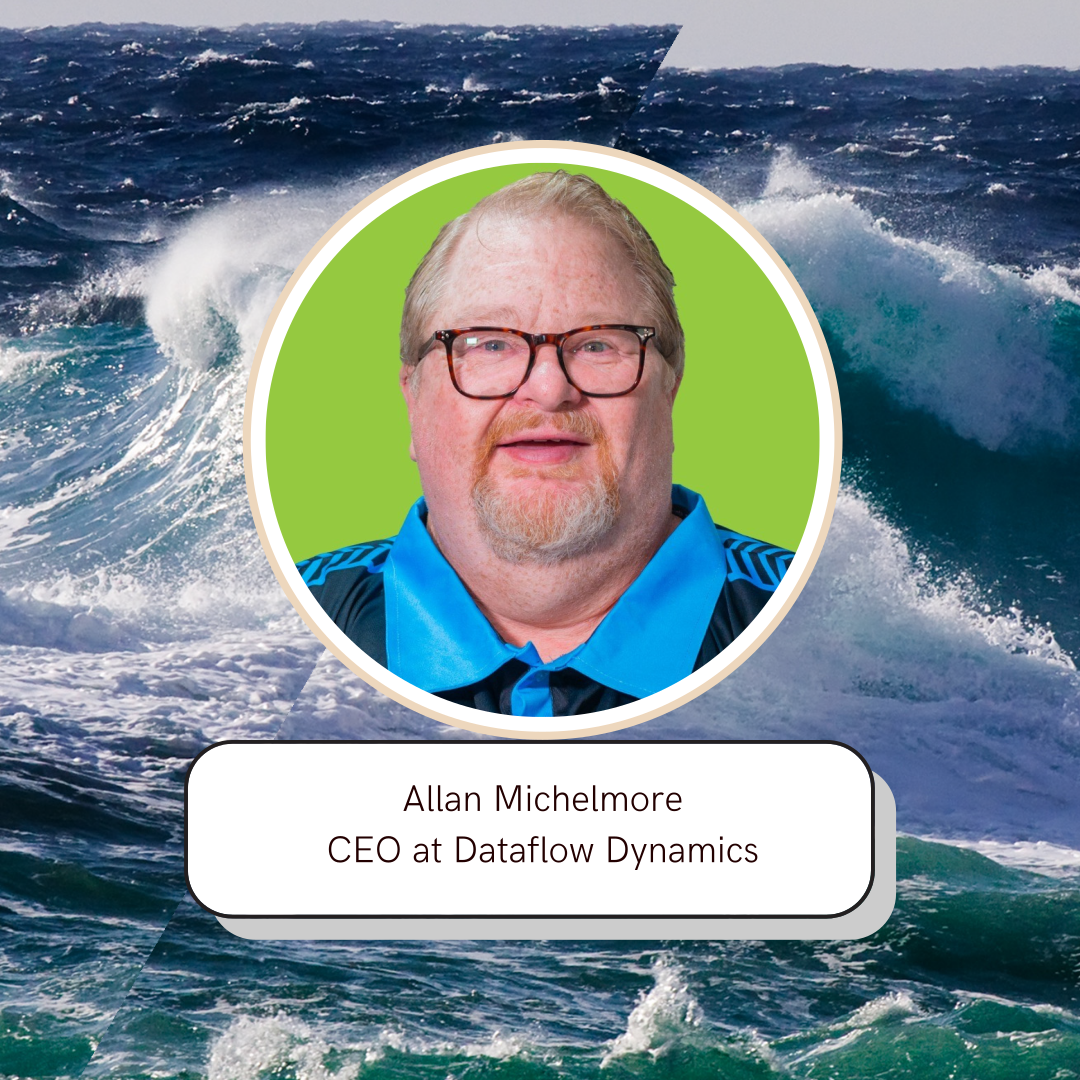
In this episode, Allan Michelmore, Managing Director of Control Networks, reinforced something we have seen repeatedly over 30 years. Offshoring can absolutely work, but not as a band aid. It works when you treat it as a service delivery decision, not a cost cutting decision. Allan has built a long running MSP and then scaled an offshore resourcing model in the Philippines well before it was fashionable. More recently, he has taken that operational experience and started supporting other MSPs with offshore technical and admin resources. His story is useful because it validates what we already know: the fundamentals are still the fundamentals.
The real offshore lever is maturity, not margin
Our view after 30 years: resourcing only scales what you already are
Every time an MSP tells us, “We tried offshore and it failed,” we ask a blunt question. What exactly did you expect a new person to plug into?
Because if your delivery system is inconsistent, undocumented, and dependent on heroics, adding people does not fix it. It amplifies the chaos. More people simply means more ways for work to get lost, misunderstood, or escalated back to the owner.
Allan nailed the biggest myth he hears. The idea that you cannot have control, cohesion, or quality with offshore staff. His practical reality is the opposite. With the right setup, offshore team members can be fully integrated into your tools, your tenant, your security posture, and your daily rhythms. They are not a separate island.
Allan’s proof point: offshore staff can be closer to the process than onshore staff
Allan described offshore staff doing far more than simple admin. In his world, offshore resources can be technical, operational, and client facing. His accounts person is also answering calls, triaging, raising and routing tickets, and chasing follow up. That is not cheap labour. That is operational leverage.
This aligns with what we have seen in mature MSPs. The winning model is not to simply send the low value work away. The winning model is to build a delivery engine where the right work is done by the right person in the right sequence, with the right checks.
SOPs are not optional. They are the price of entry
The MSP Mastery principle: if it is in your head, it is a risk
We are unapologetic about this. If your SOPs do not exist, your service is not scalable. That is true whether you hire locally, offshore, or a mix.
Allan was even more direct. He now screens MSPs based on readiness. If there are no SOPs, he will send them away to build them first. Not because he is being difficult, but because he has seen the pattern play out. Without documented process, the MSP blames the person. The real issue is the system.
This is exactly the maturity gap we see in MSPs stuck at the founder led stage. They feel busy, but the business is not stable. They feel stretched, but they do not have a repeatable way to onboard new team members without burning out senior techs.
Allan’s practical guidance: screenshots, video, and clarity beat perfect formatting
A useful SOP is not a beautifully formatted document. A useful SOP produces a consistent outcome.
Allan talked about combining documentation with visuals so someone can follow a process correctly even if they have never done it before. We agree. A screen recording in Teams or Loom, paired with simple written steps and screenshots, is enough to get started.
The bigger point is this. Documentation is not a one time project. It is a service delivery habit. The MSP that documents small improvements as they go becomes the MSP that can hire faster, delegate sooner, and reduce reliance on individual memory.
Leadership makes or breaks offshore success
The mindset shift: stop managing by checking, start managing by designing
One of the most common behaviours we see in owners is the need to review everything. It usually comes from a good place. They care about clients. They have been burned before. They know mistakes cost money.
But if your default is to double check every outcome, you have not built a delivery system. You have built a bottleneck.
Allan’s position was simple. Offshore team members are like any new team member. They need guidance, they will make mistakes early, and you will know within a couple of months whether they are a fit. The difference is not geography. The difference is whether you give them the structure to succeed.
Cultural communication is real. You must lead through it
Allan also raised something we have seen throughout the region. In some cultures, people will say yes to avoid conflict, even when they do not understand. If you do not manage this, you will get silent failure.
The solution is not blame or frustration. The solution is leadership technique. Ask them to repeat the task back in their own words. Ask what they think the next steps are. Confirm understanding before the work begins.
This is not an offshore problem. It is a communication and management problem that becomes visible when you scale beyond your immediate circle.
Integration is not a nice to have. It is the whole point
Our framework: belonging drives accountability
If you treat someone as external, they will act external. If you include them as part of the team, they will rise to the expectation.
Allan gave a great example from this episode. He took an MSP client and their partner to the Philippines to meet the offshore staff member. In just 48 hours, the staff member stepped up dramatically. Uniforms were introduced. Face to face time built trust. The team member stopped feeling like a remote resource and started acting like a true colleague.
That is the hero moment in this episode, and it is not about travel. It is about belonging.
If you want offshore to work, you need to create shared routines. Team meetings where everyone is present. Clear responsibilities. Real delegation. Normal feedback. And yes, investment in relationship. If you save meaningful salary cost through offshore, spend a portion of that saving on building rapport and trust.
Tooling and workflow discipline turn labour into profit
The principle: automation is a service delivery strategy, not a tech hobby
Allan’s consulting work around Halo PSA surfaced another recurring MSP Mastery theme. Many MSPs underuse the tools they pay for. They bolt on more systems rather than learning the capability of the platform they already have.
What matters is not the brand of PSA. What matters is whether your workflows reduce friction and create consistency.
Allan’s example: onboarding, offboarding, and billing as a single operational thread
In this episode, Allan described a practical Halo approach where the subject line triggers a workflow, tasks are allocated automatically, and completion is tracked with audit visibility. He also described creating a child ticket for accounts so that agreement updates and tool changes are handled as part of the same operational chain.
The result was not better admin. The result was billing time reduction from days to minutes. That is profitability. That is accuracy. That is less end of month stress. That is the kind of operational maturity we want MSP owners to chase because it changes the feel of the business.
The owner’s VA is often the fastest win
The MSP Mastery reality: the owner is usually doing work no owner should do
When an owner tells us they need more time, they usually mean they need fewer interruptions and fewer loose ends. Email overload, meeting coordination, rescheduling, follow ups, and basic admin are silent killers. They create cognitive load and stop the owner from doing the work only they can do, like client relationships, commercial decisions, and leadership.
Allan spoke about owners with massive unread inboxes and how a VA can function as a true executive assistant, coordinating meetings, rescheduling conflicts, and protecting focus. That is not glamorous work, but it is high value. It helps the owner step out of the operational weeds so the business can become an entity that runs with or without them.
Conclusion: Offshore is a mirror, not a magic trick
This episode reinforced what we have learned the hard way. Offshore resourcing can be an accelerator, but only when the MSP is willing to face itself.
If you have SOPs, clear workflow, and a leadership mindset that builds people into the team, offshore can improve responsiveness, consistency, and capacity. If you do not have those foundations, offshore will simply expose the gaps faster.
Allan’s experience shows what is possible when you treat offshore as part of your service delivery strategy. Documented processes, integrated meetings, real responsibility, and an investment in belonging are what make it work.
If this episode has you thinking about your own resourcing model, your process maturity, or how to get the owner out of the day to day delivery trap, reach out to us and the MSP Mastery team. We are always up for a practical conversation about what is really going on inside your MSP and what to change first so growth feels controlled, not chaotic.