Why Most MSPs Struggle to Exit and What to Do About It
After nearly 30 years of building and scaling MSPs, Nick and I have seen a consistent pattern. Owners pour everything into growing their business, but very few ever stop to design how they will leave it. The result is predictable. When the time comes to exit, they are either unprepared, undervalued, or worse, unable to step away at all. This episode of MSP Mastery: Ctrl Alt Deliver reinforced something we have been saying for decades. A successful exit is not an event. It is a strategy. And if you are not building with the end in mind, you are almost certainly leaving value on the table. Kerry Boulton joined me to share her experience working with founders on exit readiness. Her journey and the businesses she has built and sold provide a strong real world case study. But more importantly, her perspective validates the frameworks we have seen work time and time again in MSPs.
MSP Mastery
4/13/20265 min read
Why Most MSPs Struggle to Exit and What to Do About It
After nearly 30 years of building and scaling MSPs, Nick and I have seen a consistent pattern. Owners pour everything into growing their business, but very few ever stop to design how they will leave it. The result is predictable. When the time comes to exit, they are either unprepared, undervalued, or worse, unable to step away at all.
This episode of MSP Mastery: Ctrl Alt Deliver reinforced something we have been saying for decades. A successful exit is not an event. It is a strategy. And if you are not building with the end in mind, you are almost certainly leaving value on the table.
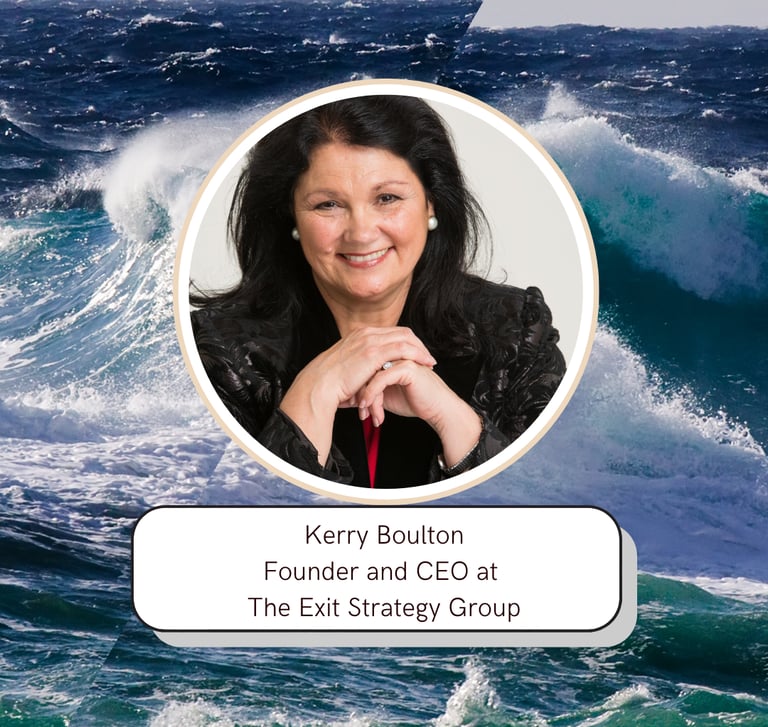
Kerry Boulton joined me to share her experience working with founders on exit readiness. Her journey and the businesses she has built and sold provide a strong real world case study. But more importantly, her perspective validates the frameworks we have seen work time and time again in MSPs.
Building With the End in Mind
Exit Is Not Optional
One of the biggest misconceptions we see in MSP owners is the belief that exit is something you think about later. The reality is much simpler. Every business owner exits at some point. The only question is whether it is on your terms.
Nick and I have worked with hundreds of MSPs, and the ones that achieve the best outcomes are the ones who make early decisions about what they are building towards. Kerry’s experience reinforces this. From her very first acquisition, she understood that if investors were involved, there had to be a clear path to liquidity.
That principle applies directly to MSPs. Even if you are the only shareholder, you are still the primary investor. If you do not understand how you will realise value, you are operating without a complete business strategy.
What we want MSP owners to take away is this. Exit planning is not about selling tomorrow. It is about building a business that gives you options.
The Business Must Run Without You
The Hard Truth About Owner Dependency
This is where most MSPs fall over.
We often say to owners, if you disappeared for a month with no phone and no laptop, what would happen? For many, the honest answer is that the business would stall, clients would escalate, and the team would struggle.
Kerry described this as making the business “you proof”, and it is exactly how we frame it in our service delivery maturity models. If your business depends on you, it is not a business. It is a job with overhead.
We saw this firsthand in our own journey. When we were approached with an acquisition offer, one of the biggest barriers was identity. Nick’s identity was deeply tied to the business. That is incredibly common in MSPs, and it is a real risk.
Kerry’s work highlights that this is not just an operational issue. It is a personal readiness issue. If you cannot separate yourself from the business, you will either delay exit or sabotage value.
For MSP owners, the takeaway is clear. Build a leadership team, document your processes, and step out of day to day delivery. Not just for efficiency, but for valuation.
Systems, Process and Consistency Drive Value
Operational Maturity Is What Buyers Pay For
Across every MSP we have helped scale, one principle holds true. Consistency creates value.
Kerry’s story about implementing total quality management aligns perfectly with what we teach through structured service delivery frameworks. Whether you call it TQM or EOS, the outcome is the same. Clear processes, defined accountability, and repeatable delivery.
Buyers are not purchasing your technical capability. They are purchasing a predictable machine.
This is where many MSPs misunderstand their value. They believe their differentiator is their people or their technical skill. But when multiple MSPs are compared side by side, those claims sound identical.
What stands out is evidence. Documented processes. Measurable performance. Consistent client outcomes.
If your service delivery relies on tribal knowledge or hero technicians, it introduces risk. And risk always reduces valuation.
Eliminating Risk Before It Is Exposed
Think Like a Buyer, Not an Owner
One of the most practical insights from this episode is the need to view your business through a buyer’s lens.
Kerry outlined several areas where risk typically hides, and we see the same issues in MSPs all the time.
Financial records are often incomplete or unclear. Contracts with clients or staff are missing or outdated. Customer concentration is too high. Key knowledge sits with one or two individuals.
From an owner’s perspective, these might feel manageable. From a buyer’s perspective, they are red flags.
We have reviewed MSP acquisitions where the entire deal collapsed because of poor documentation or unclear revenue streams. In some cases, what the owner believed was a seven figure business was effectively worth little more than a customer list.
The lesson here is simple. Remove uncertainty before someone else prices it in.
The Power of Recurring Revenue Done Properly
Stickiness Matters More Than Structure
MSPs often take comfort in recurring revenue, and rightly so. It is one of the most attractive elements of the model.
However, not all recurring revenue is equal.
Kerry highlighted the importance of stickiness, and this is something we push heavily in our advisory work. It is not enough to have monthly agreements. You need to understand how secure that revenue really is.
Are your clients contracted? Are your agreements enforceable? How strong is your client relationship? How dependent are they on your service delivery?
We have seen MSPs with strong recurring revenue models lose significant value because their contracts were weak or their clients were not truly embedded.
Recurring revenue should reduce risk. If it does not, it becomes an illusion.
The Hero Moment: The Offer You Cannot Refuse
There is a story Kerry shared that perfectly illustrates what good preparation looks like.
In her real estate business, an unexpected offer came along. It was strong, compelling, and required a decision. Because the business was systemised, structured, and not dependent on her personally, she had the ability to say yes.
That is the real goal.
Too many MSP owners assume they will choose when to exit. In reality, opportunities often appear without warning. A strategic buyer enters the market. A competitor consolidates. A private equity group makes an approach.
If your business is not ready, you do not have a choice. You either say no or accept a lower value.
Nick and I have seen both outcomes. The difference is always preparation.
Preparing Three to Five Years Out
What Actually Moves the Needle
For MSP owners who are a few years away from exit, the focus should be deliberate and structured.
First, remove owner dependency. Build a business that operates without you in the day to day.
Second, eliminate risk. Clean up your financials, formalise contracts, and ensure your data and systems are robust and documented.
Third, demonstrate performance. Collect evidence of your success. Client satisfaction, retention, and external credibility all matter.
These are not theoretical steps. They are practical levers that directly influence valuation.
Conclusion
This episode of MSP Mastery: Ctrl Alt Deliver reinforces a truth we have seen play out over decades. Successful exits are built, not negotiated.
Kerry’s experience provides a powerful case study, but the underlying principles are consistent with everything Nick and I have learned in the MSP space. Businesses that are systemised, transferable, and strategically positioned always outperform those that are reactive and owner dependent.
If you take nothing else from this, take this. Start thinking about your exit now. Not because you are ready to leave, but because it will force you to build a better business.
A Final Thought
If you are unsure where you stand, it is worth stepping back and asking a simple question. Could your business run without you, and would someone else pay a premium for it?
If the answer is unclear, that is where the work begins.
If you want to explore what this looks like in your own MSP, reach out to Nick and me or connect with the MSP Mastery team. We are always up for a conversation about how to turn a good business into one that delivers real value when it matters most.